
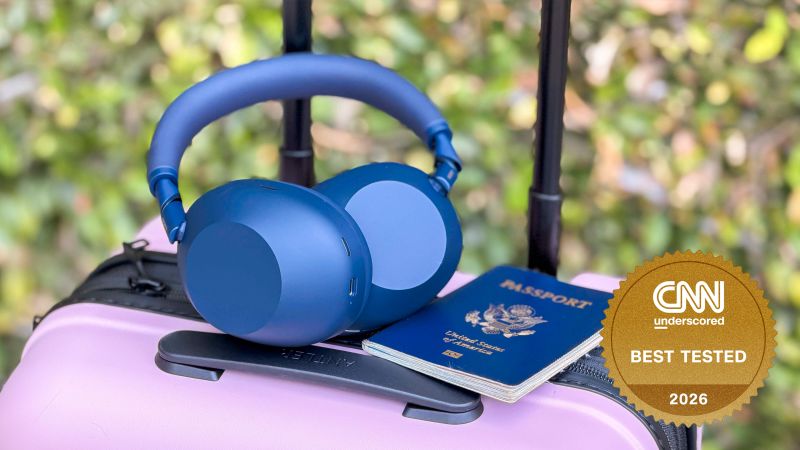
I’ve been to six continents and never visited any of them without a pair of travel headphones. After all, even though travel is almost always an exciting adventure, it has its challenging moments, and a good pair of headphones always helps, whether I’m dealing with a fellow flier’s crying baby on a long-haul flight, an hours-long bus ride in the Colombian countryside or a very loud club across the street from my city hotel room.
Travel headphones aren’t just for listening to music on travel days and catching up on movies on the plane. To me, they’re a lifeline, a break from the tourist bustle, an inspiring soundtrack while relaxing at the beach, even a sleep aid to catch some zzz’s despite the rough conditions of economy class.
When choosing headphones for flying and travel, portability, versatility and battery life are just as important as sound quality, comfort, noise cancellation and affordability. Since I’ve traveled with more than my share, let me help you find the ideal pair for your travel gear. Of the 12 travel headphones I’ve tested so far, these four are the best.
Best travel headphones

These aren’t just the best-sounding over-ear headphones on the market: Their noise-canceling performance is superior as well. Their call quality could be better, and they are expensive. But overall, these are a worthy splurge.
Best budget travel headphones

While their controls and call quality aren’t the best, these budget noise-canceling earbuds from Soundcore punch above their weight in sound quality and noise cancellation performance. They also offer up to 48 hours of battery life with the case.
Best travel headphones with a transmitter

These lesser-known over-ear headphones are a revelation. They prove that you don’t have to limit yourself to Sony, Bose or Apple to enjoy punchy audio and good noise cancellation. These come with a nifty transmitter that pairs well with in-flight entertainment systems.
Best travel in-ear headphones

You can’t go wrong with Apple’s flagship earbuds, whose ease of use, weatherproofing and call clarity scored above the pricier Sony WF-1000XM6. Of course, the audio and noise cancellation are impeccable, too.

As a lifelong Bose user, I resisted Sony headphones for years, partly because I preferred the neutral sound profile of Bose’s older models, but mostly because I grew up using that brand’s products. So, it takes lot for me to admit that the Sony WH-1000XM6 have the Bose QuietComfort Ultra Headphones Gen 2 beat, albeit by a small margin.
Not that the Bose Ultra 2 headphones aren’t impressive, but Sony’s latest flagship wins in active noise cancellation performance and ambient mode. The Sony headphones block out loud noises, including plane engines, with incredible effectiveness, and their excellent, natural-sounding transparency mode lets you listen to airport announcements without straining your ears.
There is a noticeable hiss when in transparency mode, but it’s less audible when you’re playing music. Hiss or not, if you’re seeking a pair of versatile over-ear headphones that will let you travel with ease, that’s a very promising start.
And of course, the sound quality is excellent as well. The audio is well balanced, clear and detailed with great bass and a lot of depth. If you aren’t a fan of the default sound profile, the app’s 10-band equalizer (EQ) lets you tune the audio to your liking.
I should say that the Bose QuietComfort Ultra Headphones Gen 2 are a better prospect in terms of portability and comfort. They have plusher and roomier ear pads, less clamping force and a sleeker carrying case, while the Sony WH-1000XM6 gives me a slight headache when I wear them for long periods, and they come with a bigger, bulkier case.
However, these differences aren’t massive, nor are they deal-breakers. The Sony headphones are still very comfortable and portable, thanks to their lightweight 0.56-pound design and soft, plush ear pads. You may just need to break them in first to reduce that clamping force.
The two headphones are toe-to-toe on battery life, both lasting up to 30 hours of listening time on a full charge with ANC on, and connectivity, as both have a 3.5-millimeter audio jack you can connect to in-flight entertainment systems if you don’t have a Bluetooth transmitter, and both offer simultaneous connectivity so you can connect to two devices at once. Neither travel headphone offered weatherproofing or sweat-resistance.
When it comes to call quality, however, the Sony WH-1000XM6 wins again. I found them better at background noise reduction, decently minimizing the noise around me when I was chatting with someone in a busy airport. The person on the other end sounded far away and a little muffled, and I was told my voice sounded faintly distorted. But we both came through clear and comprehensible. Sadly for Bose, the call quality on the Bose QuietComfort Ultra Headphones Gen 2 wasn’t as good.
Probably the biggest downside to these Sony headphones is the price. Not only are they $10 pricier than the Bose, that means they also cost $460, which feels outrageous to most people. Are they worth it? Even if you’re not too particular about sound quality or noise cancellation, the Sony WH-1000XM6 are still the best travel headphones money can buy.

Despite the sea of ANC options in the oversaturated headphones market, there are very few budget-friendly options that offer good sound quality and decent noise cancellation. Even a brand as well known as JBL can be a hit or miss with their budget offerings.
Soundcore, however, has built its reputation from making affordable headphones that punch above their weight in audio performance, and the Soundcore Liberty 5 are the perfect example.
I don’t want to hype these budget travel headphones too much, because there are some things I think Soundcore could have executed better. But for a pair of ANC earbuds under $150, you’re getting excellent bang for your buck here.
The sound quality, for example, may not have as much depth and detail as high-end models, but these headphones deliver punchy bass and good audio overall. Plus, there’s good EQ via the app so you can hone the sound to your liking.
That’s not all. The ANC is great, especially for the price, and very effective at blocking low frequencies, including the low rumble of plane engines. I also appreciated the transparency mode. Even if it’s not as natural as I would have liked, it let me hear things like gate announcements and train stops without having to pause what I was listening to.
Of course, since they’re on the cheap side, the Soundcore Liberty 5 aren’t perfect. The controls aren’t especially responsive, which could be frustrating when I was trying to change songs while exploring a town. And making calls could be annoying because there seems to be no background noise isolation and the person on the other end often sounded far away.
Because they don’t push my voice forward or lower the background noise when I’m on a call, it was honestly just easier for me to remove one earbud and switch to my phone when I was in a busy area. They also seemed to distort my voice.
But two flaws on a pair of ANC earbuds for only $130 isn’t shabby, especially considering that they are comfortable to wear for hours, pocket-friendly and water-resistant with an IP55 rating. They’re even dust-resistant, in case you find yourself in the middle of the Sahara or a dusty Moroccan town. It’s worth mentioning that they also boast fast charging (10 minutes of charging gives you 5 hours of listening time) and offer up to 12 hours of battery life on a single charge (48 hours with the case).
These are high-end features in a very accessible package, something Soundcore does best. Are the Soundcore Liberty 5 the cheapest travel headphones you’ll find on the market? Hardly. But will they give you the best bang for your buck? So far, yes.

What’s rough about doing these guides is that sometimes, there isn’t just one obvious winner that blows the rest out of the water. Sometimes, there are so many great products in one testing pool that it’s hard to whittle down the list to the top three, which is why I’m squeezing in this pair from JBL.
I’m not really a JBL headphones user, or at least, I haven’t tested that many from the brand’s lineup. So when I first put on the JBL Tour One M3 Smart TX and started listening to my favorite tunes, I was pleasantly surprised by how great they sounded.
The audio response on these headphones is incredible: well-balanced, crisp and detailed with punchy bass and rich midrange. The spatial audio is good, and in addition to the presets, the app includes a 10-band EQ to fine-tune the sound.
The noise cancellation isn’t as impressive as on the Sony WH-1000XM6, but it works just fine, minimizing plane engine noise and other offending sounds. I do like the two fairly natural-sounding transparency options: ambient aware, for hearing things like airport announcements and oncoming cars, and TalkThru mode, so you can ask for directions or purchase train tickets at the station without taking the headphones off. I don’t like to expend energy when I don’t have to, so the fact that I don’t have to take them off to stay connected with the outside world is a nice perk.
The JBL Tour One M3 Smart TX aren’t as portable as the Sony or the Bose QC Ultra. The headphones are slightly heavier, their case is slightly larger than Sony’s and they also come with a small transmitter. While I didn’t feel the difference in weight, I certainly noticed the space the case was taking up in my personal item bag.
I didn’t mind it that much, though, because here’s the thing: of all the travel headphones I tested, these are the only ones that seemed to have been designed specifically with travel in mind. They come with their own transmitter, the JBL Smart TX, which not only ports directly into a plane’s in-flight entertainment system via the audio jack so you can enjoy a cable-free experience but also has a responsive touch display that lets you change songs, toggle settings and more. The latter is handy if you don’t want to pull out your phone.
Is it a necessary accessory? That depends. If you don’t mind connecting your headphones directly to the in-flight system, then probably not. The headphones’ capacitive touch controls are also among the most responsive and forgiving I’ve seen and used — though I should warn you that they can be too sensitive. I found that when an arm so much as touches the panel, like when I’m reaching up to grab my bag from an overhead bin, it pauses whatever’s playing.
However, if you prefer a wireless experience, it comes in very handy. Personally, I love using my Twelve South AirFly Pro 2 transmitter when flying because I don’t like being physically tethered to the in-flight system. Plus, the JBL Smart TX is a safer thing to hold when I’m on a bus in Colombia and don’t want to put my phone on full display.
Another huge perk of the JBL Tour One M3 Smart TX is the whopping 70-hour battery life. This is with noise cancellation toggled off, but even with it on, you’re still getting about 40 hours — longer than most flagship headphones in this price range.
To round it out, these headphones also have the best call quality of all the over-ear headphones I tested. The background noise reduction works beautifully, and while there’s the faintest hint of distortion, the audio quality is almost as clear as on my iPhone 17 Pro. None of the other over-ear options in the testing pool came this close.
Considering all that and the fact that the JBL Tour One M3 Smart TX are $10 cheaper than the Sony WH-1000XM6, it’s clear they deserve a spot on the travel headphones winners list.

There’s no doubt that the Apple AirPods Pro 3 are among the best in-ear headphones in their class. Their audio performance is nearly unrivaled: well-balanced, very detailed and great bass presence. Apple’s hearing protection and spatial audio features are also well-executed, and their active noise cancellation is just as impressive, ensuring that you can isolate yourself from all the chaotic sounds of travel when you need some quiet time.
The AirPods Pro 3 have, hands down, the easiest, most responsive and most intuitive controls of all the earbuds I’ve tested. They actually make a massive difference when I’m walking through airports and navigating an unfamiliar town with my suitcases in tow.
The stems don’t just make them easy to put on; they also house the responsive touch controls that let you effortlessly control your media, adjust the volume, toggle listening mode and even turn on the Live Translation feature. More than that, though, they can intuitively tell the difference between me just putting them on, taking them off or repositioning them versus actually using the controls. That considerably reduces accidental presses, which I found to be very common with other earbuds.
The earbuds’ IP57 weatherproof rating is also among the highest out there — not even the Sony WF-1000XM6 and the Bose QuietComfort Ultra Earbuds (2nd Gen) come close with their IPX4 rating. I can get caught in a downpour in Andalusia, which has already happened to me a couple of times, and not worry about my travel headphones. Adding to that is the fact that these earbuds seem to have impressive holding power; I ran with them a few times, and neither my sweat nor my clumsy steps loosened them from my ears.
Like the JBL Tour One M3 Smart TX, there are also travel-forward features on the Apple AirPods Pro 3 that you’d be hard-pressed to find elsewhere. The Live Translation feature, despite still being in beta during my testing, works well and is especially helpful when in a non-English-speaking country. At the time of writing, it supported only 10 languages, one of which was English. It’s also a feature that takes some getting used to — I found it hard to hear the person I’m talking to with the live translations also playing in my ears.
These earbuds also moonlight as your iPhone’s camera remote; as a solo traveler, this feature makes it easier for me to take tripod-mounted photos, especially of myself. I no longer have to rely on the timer and some cardio just to have photos of myself on vacation.
Other travel-useful additions, which are available in other earbuds like the Sony WF-1000XM6, are the head gestures that will let you accept or decline calls and notifications by just nodding or shaking your head, and the conversation awareness feature, which, when turned on, automatically lowers the volume when the earbuds hear you talking with other people. The latter isn’t perfect; it activates every single time I start singing along, which I do often, and sometimes when I’m at the gym on the treadmill. Still, the feature comes in handy on travel days when I do have to talk to ticketing agents and flight attendants.
Lastly, these boast excellent call quality, comparable to that of the JBL Tour One M3 Smart TX. Both parties on the call come through clearly and loudly, and the background-noise rejection is fantastic and natural-sounding.
One nitpick I have is that I wish the battery life were longer. With ANC on, you’re only getting eight hours of listening time. However, the case gives you 16 more hours (for a total of 24 hours), which is more than enough even on longer travel days.
The Apple AirPods Pro 3 are on the pricey side at $250, but with all these travel-useful features you’re getting, they are worth the splurge if you’re looking for the best travel earbuds.

Logging hundreds of hours of flight, train, bus and even car travel, I tested each pair of travel headphones and earbuds in my testing pool to gauge their audio performance, ease of use and overall value.
More specifically, for travel, I wanted to find out if each pair offered excellent noise cancellation, superior comfort for hours of use, portability and long battery life. A pair also got bonus points if they had good weatherproofing and connectivity to in-flight entertainment systems.
During testing, I evaluated each pair using the following primary criteria:
-
Sound quality: This can be subjective — some listeners, for example, love bright audio with a boosted high end, while others prefer a warmer sound profile with a richer midrange and bigger bass. More critical listeners, for the most part, prefer a more neutral sound profile. Because so much of a person’s taste goes into whether they like a pair of headphones’ sound quality, I just focused on clarity, balance, frequency range and how customizable the app’s equalizer (EQ) is.
-
Noise cancellation: You want your travel headphones to offer active noise cancellation (ANC) to drown out the sounds of plane engines, crying babies, loud-mouthed passengers and even the gaggles of tourists in popular spots. But I also looked for a natural-sounding transparency mode so that you won’t miss airport flight announcements, your bus stops or signs of danger when you’re exploring a new town, especially at night.
-
Battery life: For this guide, I settled on testing headphones that offered at least 24 hours of battery life on a single charge with ANC on, which should get most travelers through long travel days, even when flying overseas with multiple layovers.
-
Call quality: Call clarity is important when you’re traveling, whether for staying in touch with loved ones or for emergencies. Sadly, I found that only a few headphones, even in the flagship category, can match the call clarity smartphones offer. The way I judged this was that as long as I could clearly hear the person on the other end, they could hear me, and there was decent background noise reduction, then it was fine.
-
Weatherproofing: Because of their design, over-ear headphones don’t usually promise any sort of weatherproofing or sweat-resistance, but since many earbuds do, I’m treating this as a bonus. If you like to travel during the shoulder seasons, when you’re likely to encounter bad weather, you might want to invest in travel headphones with weatherproofing.
-
Ease of use: I love a pair of headphones with a touch panel, but that feature isn’t always executed well, especially on earbuds, where there’s little surface area. So, whether a pair of travel headphones uses capacitive touch or physical buttons, I made sure they were easy to control on the go.
-
Portability: Travel earbuds are pocket-friendly, but over-ear and on-ear headphones are a different story. They take up a lot more space, even the foldable ones. And when you’re traveling, the lighter your load and the less space items take up, the better. For this reason, I immediately excluded most non-foldable models and kept the pool to the foldable ones with actual carrying cases. I also judged each pair on how light they are and how easy to put away.
-
Comfort and breathability: Solid clamping force and breathability are big factors when buying travel headphones. After all, you don’t want to spend a six-hour or longer flight with your headphones putting pressure on your head. Excessive clamping force can lead to a bad migraine — I know because I once spent an entire night nursing one in my dark bedroom after wearing a really tight pair of gaming headphones for only an hour. Meanwhile, poor breathability can cause sweating, especially if the cabin you’re in is already warm. As for earbuds, you want to make sure that the pair you choose isn’t too big for your ears or too small to handle with ease.
-
Fit: Whether you’re getting travel headphones or earbuds, you’ll want them to fit well and stay put even when you’re rushing to your next airport gate or riding a tuk-tuk on unpaved roads.
-
Connectivity: The headphones and earbuds I tested are all wireless with Bluetooth connectivity, because cable-free is just the way to go when you’re traveling. However, in-flight entertainment systems on planes are still old-school, so I gave bonus points to models that come with a 35mm audio jack or a wireless transmitter with a 35mm connector.
My picks above may have come out on top based on my testing criteria, but that doesn’t necessarily mean one of those pairs will be the best for your specific needs. As an example, the Apple AirPods Pro 3 may have beaten all the other earbuds I tested, but if you’re not an iPhone user, you will be dealing with limited functionality.
Here are some other things to consider when choosing the best travel headphones for you, beyond my criteria above.
If you appreciate and want to prioritize exceptional sound quality and best-in-class active noise cancellation, then be prepared to spend anywhere from $250 to $500 on a pair of travel headphones. That’s just the reality of it. If you have the dough, these headphones are worth the investment.
However, if you’re on a tight budget, know that you’re unlikely to get those high-end features from an under-$100 model. The good news is, if you’re willing to compromise a little on sound and active noise cancellation (ANC), you’ll find good options from the midrange shelf.
Brands like Sony, Bose and Apple have more affordable models under $200, like the Bose QuietComfort Earbuds, Sony WF-C710N and Beats Powerbeats Pro 2, that deliver great audio and noise cancellation, even if they’re not on par with the high-end models.
There’s another brand that has been consistently rolling out affordable, good-quality headphones and earbuds: Anker’s Soundcore. Its Soundcore Liberty 5 earbuds, my best budget pick, punch above their weight in sound quality and ANC.
Over-ear headphones can accommodate larger drivers than in-ear earbuds, but that doesn’t necessarily mean better sound quality. Without going into the weeds, essentially, the difference in size between in-ear drivers and over-ear drivers isn’t important because earbuds bypass the outer ear and send sound directly into the inner ear, whereas over-ear headphones do not have that advantage, so they require bigger drivers.
Over-ear headphones do have an advantage over their in-ear counterparts in noise cancellation because they have better passive noise cancellation. Thanks to their over-ear design, they naturally block out sound better than earbuds do.
Ultimately, the choice between these two forms is largely dependent on your comfort level and preferences. Some people might find over-ear headphones too hot to wear for long periods, especially on travel days when they’re transferring between terminals or from an airport to a bus stop. Some might also find them too bulky, despite lightweight designs and carrying cases.
On the other hand, I also know some people who cannot wear in-ear headphones for too long because they hurt their ears. And while they are more portable, they’re also much easier to lose.
Many people still prefer wired headphones because they are generally cheaper, offer the same sound quality and don’t require charging or app support.
But as someone who’s used both on airplanes, I find wireless headphones more convenient. Traveling is fun, but it’s seldom easy, so having one fewer wire or cable to worry about makes a difference, especially when you’re in the close quarters of economy class and have seatmates that need to get past you to go to the bathroom.
Many of the current wireless headphones also have long battery lives, so you won’t need to charge as often as you think you would.

Among the best over-ear headphones on the market, the QC Ultras deliver excellent sound quality and incredible comfort. Unfortunately, they’re just a little behind the Sony WH-1000XM6 on ANC performance.
The Bose QuietComfort Ultra Headphones (2nd Gen) are some of the best over-ear headphones for travel on the market right now, offering rich, highly detailed audio with booming bass, excellent noise cancellation and a good transparency mode. They do have a slight advantage over the winners, the Sony WH-1000XM6, in comfort, thanks to thicker, plusher ear pads and a slightly looser yet still secure fit. They also have the soundstage-widening Immersion mode for a more immersive movie-watching experience.
However, the Sony headphones have better noise-canceling performance, offer more fine-tuning with the app’s 10-band EQ and provide better background noise reduction during calls, making them a slightly better choice. I also noticed that the volume touch slider on the Bose QuietComfort wasn’t as responsive as I’d like it to be.

These underrated over-ear headphones from Marshall go back to basics with their controls and old-school design. There are things that could have been executed better, especially at their price range, but there are also rare, great features.
When it comes to sound quality and noise cancellation, there are definitely many better options on the market. I’ve been a fan of Marshall’s headphones for years, but I’m also the first to admit that while the Marshall Monitor III ANC have decent ANC, crisp highs and good bass presence, they are largely middle-of-the-road in terms of performance. Even though the EQ on the app has only five bands, the soundstage feature doesn’t really widen it much, and the call quality is nothing to write home about.
There are a few things I really liked about them, though. I loved that old-school, rock ’n’ roll-inspired design, as well as the floating silicone headband, which reduced pressure on my head. And I absolutely adored the controls, which consist of a joystick you can use for power, volume, forward and rewind, pause and play and answering calls, and two buttons placed strategically at each end of the yoke. These make the headphones so incredibly easy and intuitive to control that I honestly didn’t miss the touch controls of pricier models.
Plus, the Marshall Monitor III ANC have the longest battery life of all the models I’ve tested so far, giving you up to 70 hours with ANC on and up to 100 hours with it off. At $380, these aren’t necessarily the best value for your money, but one cannot help but love them.

This midrange entry in Bose’s QuietComfort line is a great performer, too. They don’t have the Bose QC Ultra’s luxurious frills, but they’re better than many headphones in their class. The fact that they’re cheaper and lighter than the Ultra and the Sony WH-1000XM6 makes them an appealing choice for many travelers.
Think of the Bose QuietComfort as the QuietComfort Ultra’s little brother. They don’t have the high-end features the Ultra has, but coming from the same family, they have the same great genes.
For example, they don’t have the Ultra’s Immersive Audio feature and premium audio, but they still deliver good sound quality with great depth, punchy bass and well-represented mids and highs. Their noise cancellation isn’t top-of-the-line, but they’re definitely better than other travel headphones on the market. There’s no capacitive touch panel, but their physical buttons aren’t hard to operate. And instead of a 30-hour battery life, they’ll last 24 hours.
Honestly, if you’re not looking for the most premium audio and ANC, you’ll love these headphones, which are just as comfortable as the Ultras in my opinion. What really turned me off, though, is the price tag. These travel headphones are great, but do they really cost $360? CNN Underscored testing writer Alex Rennie, who isn’t a big audio guy, said they look to him like they would cost $200, and I kind of agree.

Sony’s latest in-ear headphones entry goes all out on audio performance, with excellent clarity and detail. They also fit surprisingly well and stay put even on smaller ears. However, their weatherproofing, noise cancellation and call quality fall short compared to the AirPods Pro 3.
I loved testing the Sony WF-1000XM6. They sound incredible, pumping out clear, well balanced and detailed audio with a lot of oomph and depth. If that isn’t enough, you can always fine-tune the sound with the app’s 10-band EQ. Admittedly, they feel a little too big for my ears, but they fit well, stay put and don’t hurt my ears even after hours of use, so there’s not much to complain about here.
Here’s the tricky thing, though: The Apple AirPods Pro 3 are almost $100 cheaper, are more intuitive to use, and have better weatherproofing and call quality. More importantly, they boast superior active noise cancellation. The Sony WF-1000XM6 go big on the sound, but everything else, you can get better for less with Apple’s offering. The only reason to skip my pick for best in-ear headphones is if you’re not invested in the Apple ecosystem.

Another affordable travel headphones candidate, these Bose in-ear headphones punch above their weight in sound and noise cancellation. They also come with fancy frills like wireless charging and voice control, which are nice surprises for a pair in this price range.
If you’re looking for affordable travel headphones, the Bose QuietComfort Earbuds are absolutely worth checking out. They perform better than their price tag suggests in audio quality, noise cancellation and transparency mode. They’re also comfortable to wear, despite being on the bigger side, and offer a very secure fit.
It’s worth noting, though, that their battery life of 8.5 hours with ANC on could be better, the app’s five-band EQ does limit sound fine-tuning and the call quality isn’t the best. However, the fancy frills, which I wouldn’t have expected from Bose in this price range, might make up for those flaws. The case works with wireless charging and the earbuds themselves come with built-in voice control so you can do things like toggle the settings, change volume, play or pause media and more without lifting a finger. You can even use it to command your phone to take photos.

These in-ear headphones are so tiny, they’re almost covert. Despite their size, they sound fantastic and boast excellent noise cancellation. However, their average call quality and not-so-intuitive controls hold them back.
Besides my Google Nest Wifi Pro, I don’t use Google devices, so I had no idea what to expect from the Google Pixel Buds Pro 2. Luckily, they live up to the hype, thanks to their fantastic audio performance with well-represented highs and mids and good bass. While the transparency mode is just OK, the noise cancellation is great. And when it comes to call clarity, they’re better than many of the pricier models in this lot.
Despite their tiny size, they were easy to put on and secure for a comfortable fit. I also appreciate that the case they come with provides up to 30 hours of battery life and that both the earbuds and the case are weatherproof.
However, I’d still spend those few extra dollars for the AirPods Pro 3 instead. The Google Pixel Buds Pro 2 touch controls aren’t the most intuitive and often confuse what I’m trying to do with something else (when I’m sliding to adjust the volume, for example, they always think I’m trying to pause the media), whereas the AirPods Pro 3’s controls are near impeccable.

With a design that lets them transform from in-ear headphones to open-ear ones, these sports headphones are among the most versatile of the bunch. Other features are just as rad, including the IP55 rating, especially considering their sub-$200 price tag.
The highly versatile Soundcore AeroFit 2 Pro remind me of the JBL Tour One M3 Smart TX in that both headphones try harder than all the other models to give you the biggest bang for your buck. While these in-ear headphones from Soundcore don’t have JBL’s transmitter, they do have a design that lets you use them as either in-ear headphones or open-ear earbuds, depending on how you wear them. You’re essentially getting two headphones in one, which is pretty nifty considering their sub-$200 price tag.
These being Soundcore, they’re worth the money in other ways too. The audio is decently balanced, noise cancellation is good, transparency mode sounds fairly natural and, with the case, you can enjoy up to 34 hours of listening. Unlike the Beats Powerbeats Pro 2, they have protection against low-pressure water jets and partial protection against dust ingress.
The Soundcore Liberty 5 were named the best budget travel headphones instead of these because of their universal design and more affordable price tag. But if you’re looking for something that’s both sporty and budget-friendly, the Soundcore AeroFit 2 Pro are also worth considering.

These in-ear headphones designed for athletes would have been great for traveling, thanks to their long battery life with the case, impressive call quality and incredibly secure fit. On top of that, they sound really great. However, there are also a couple of things that missed the mark.
I love my Beats Powerbeats Fit, so I honestly thought I would feel the same about the Beats Powerbeats Pro 2. Don’t get me wrong, these sound just as good, with rich audio and punchy bass. In terms of battery life, you’re getting up to 45 hours, which is much longer than the AirPods Pro 3. Finally, the call quality is impressive, with calls coming through clear and minimal background noise bleeding in.
However, unlike the Powerbeats Fit and the AirPods Pro 3, these proved hard to put on — it took some practice to secure one in my ear while sliding the hook in with one hand without pressing any controls. That’s something I’d rather not deal with when I already have my hands full with all my travel stuff. Plus, their active noise cancellation isn’t anything to write home about.
The best travel headphones for flying are those that offer excellent noise cancellation and transparency mode, have an all-day battery life, are comfortable to wear for long periods, are portable and boast superior sound and call quality. They should also provide easy and intuitive operation.
Both wireless and wired connectivity come in handy, but wireless earbuds don’t support wired connectivity, so you may want to invest in a Bluetooth transmitter like the Twelve South Airfly Pro 2. Also, most over-ear headphones are not weatherproof, so if that’s necessary for your travels, in-ear earbuds are the way to go.
Yes, noise-canceling headphones are absolutely helpful for travel. Superior active noise cancellation can drown out common travel sounds, from plane and motorboat engines to tourist crowds and late-night noise outside your hotel room.
Besides quality ANC, you should also look at a pair of headphones’ transparency mode. It should sound natural and help you hear background noise, such as airport announcements, clearly.
Although a handful of models can last up to 70 hours on a full charge, most headphones and earbuds offer 24 to 30 hours of battery life with ANC enabled. That’s more than enough to get you through most long-haul flights. Most airports, train stations and bus terminals these days have charging stations and outlets, should you find yourself on a particularly unlucky travel day that’s lasting longer than expected.
CNN Underscored editors and writers ensure every product included in an article is thoroughly vetted and something we ourselves would feel comfortable buying and using. Our team has many decades of collective experience researching, testing and recommending products across every category — from fashion and food, to home goods and health, to electronics and everything in between — and we’re committed to using that expertise to help you make the most of your money and live a better life.
For this article, CNN Underscored testing writer Michelle Rae Uy tested all 12 headphones herself. She boasts years of experience writing product reviews on travel products and covering travel gear for various publications before joining CNN Underscored. She wrote our guides on the best luggage sets, best weekender bags, best personal item bags and best packing cubes.